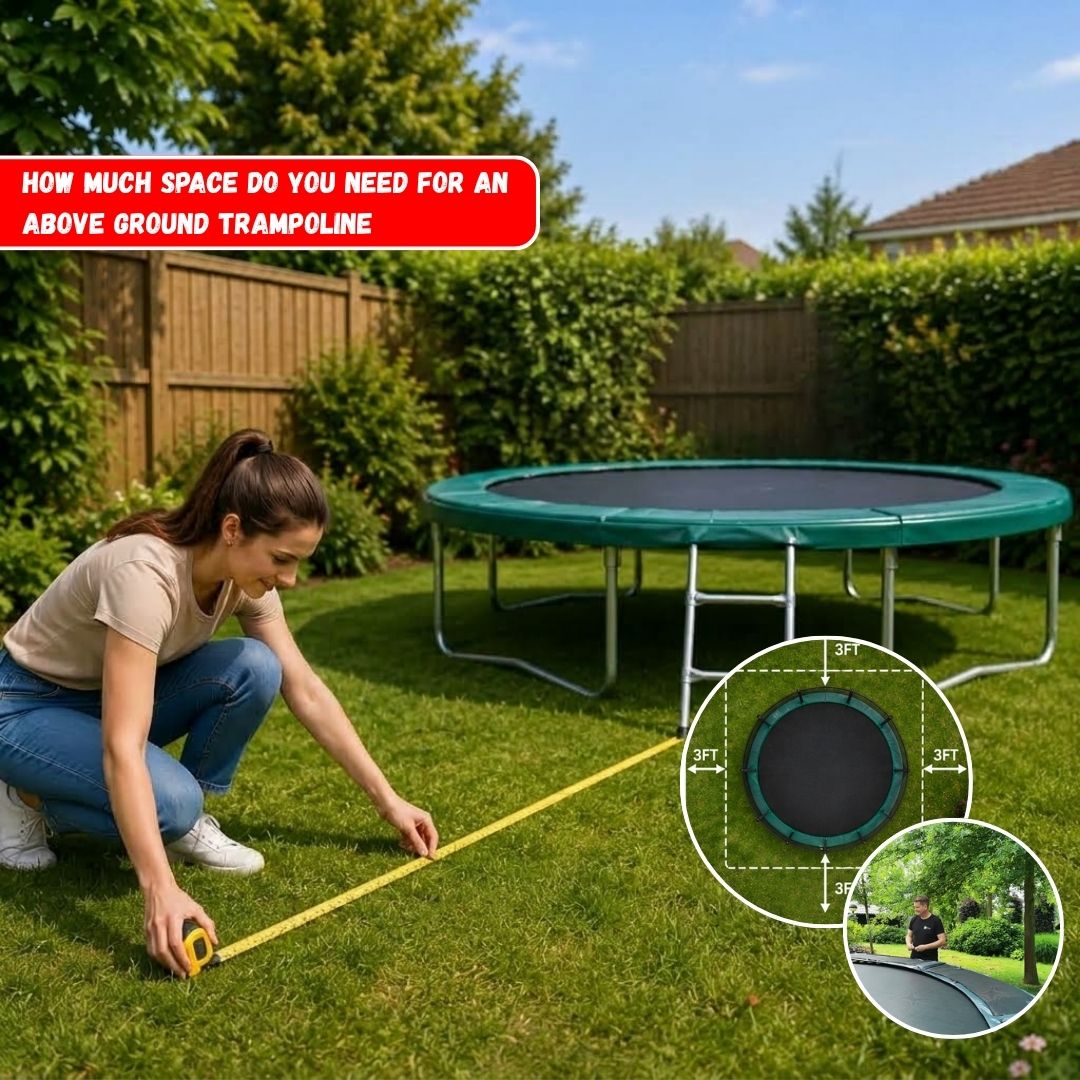
A 10ft above-ground trampoline doesn’t need 10ft of garden space. It needs a lot more than that, and this is where most buyers get caught out.
Every year, thousands of parents order an above-ground trampoline online, wait for delivery day, then stand in the garden wondering why the box seems bigger than the space they’d planned for it. It’s an easy mistake to make. The size printed on the box refers to the jumping surface, not the total footprint you actually need once you factor in clearance, poles, and netting.
So, how much space do you need for a trampoline? Enough for the trampoline itself, a clear safety zone around it, and enough headroom above it too. Get your tape measure out before you get your wallet out this guide walks you through exactly what to measure and why.

How Much Space Do You Need Around an Above-ground Trampoline?
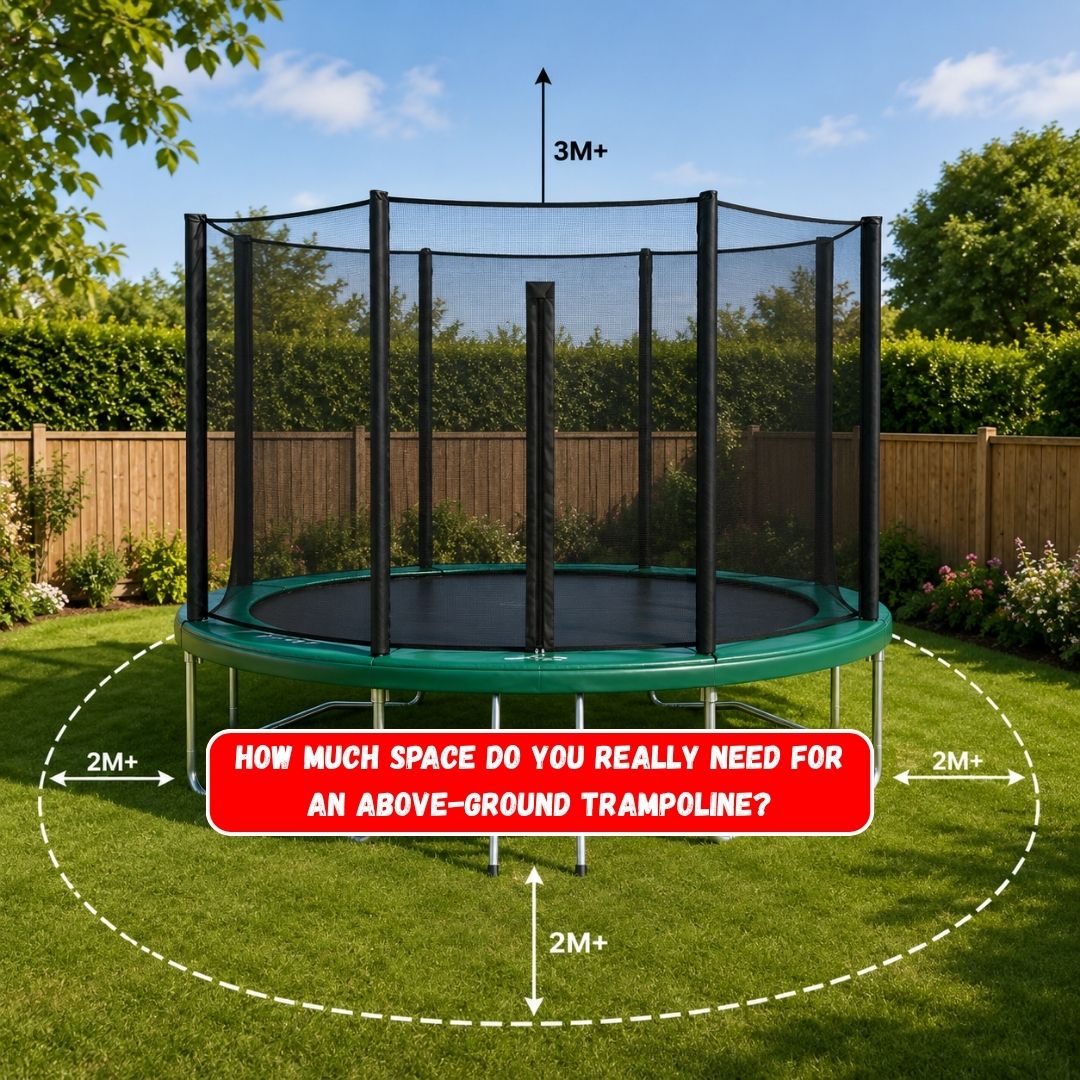
You need the garden trampoline‘s own footprint, plus roughly 3–5ft (0.9–1.5m) of clear space on all sides, plus overhead clearance free from branches, wires, or roof lines. Manufacturers vary in what they recommend, so always check the instructions that came with your specific model, that figure overrides any general rule of thumb.
Clearance space is the buffer zone that keeps a bouncing child away from anything solid. It’s not optional extra padding, it’s the difference between a fall onto grass and a fall onto a fence post.
A lot of people measure the trampoline box and stop there. That’s the mistake. The advertised diameter or length tells you the size of the jumping mat, not the total area you’ll need to clear in your garden.
What Counts as an Obstacle Nearby
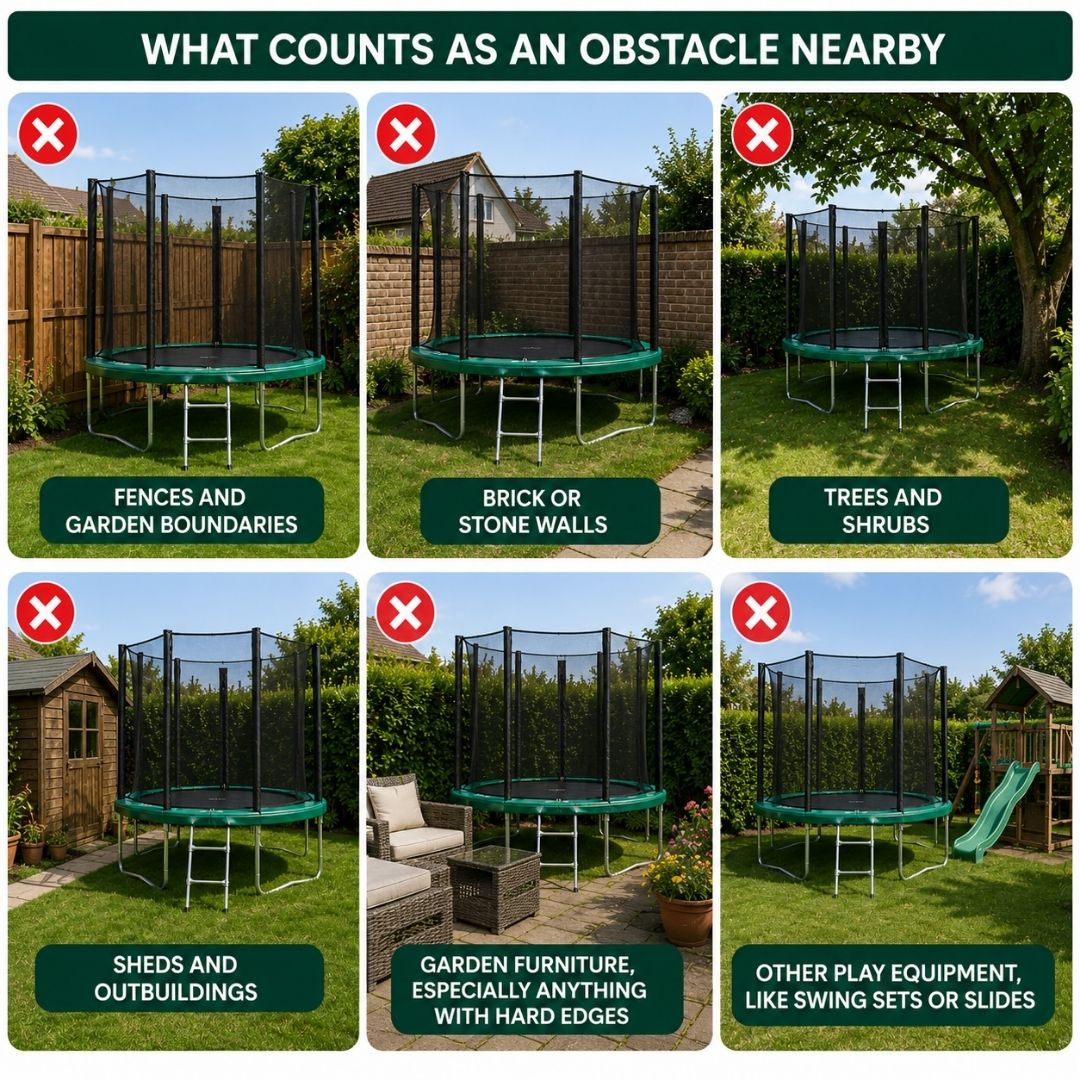
Keep this clearance free from:
- Fences and garden boundaries
- Brick or stone walls
- Trees and shrubs
- Sheds and outbuildings
- Garden furniture, especially anything with hard edges
- Other play equipment, like swing sets or slides
The ground within that zone should stay soft and obstacle-free too: no ornamental rocks, no plant pots, nothing a child could land on badly.
Overhead Clearance Matters Just as Much
It’s easy to forget to look up. Branches, washing lines, satellite cables and low roof overhangs all pose a genuine risk once someone starts bouncing several feet into the air. Some manufacturer guidance recommends as much as 7m (around 23–24ft) of clear overhead space, though this depends heavily on the trampoline’s bounce height and the standard the manufacturer is working to. If in doubt, measure the highest point a jumper is likely to reach and add a generous margin above it.
How Do You Measure Your Garden for a Trampoline?
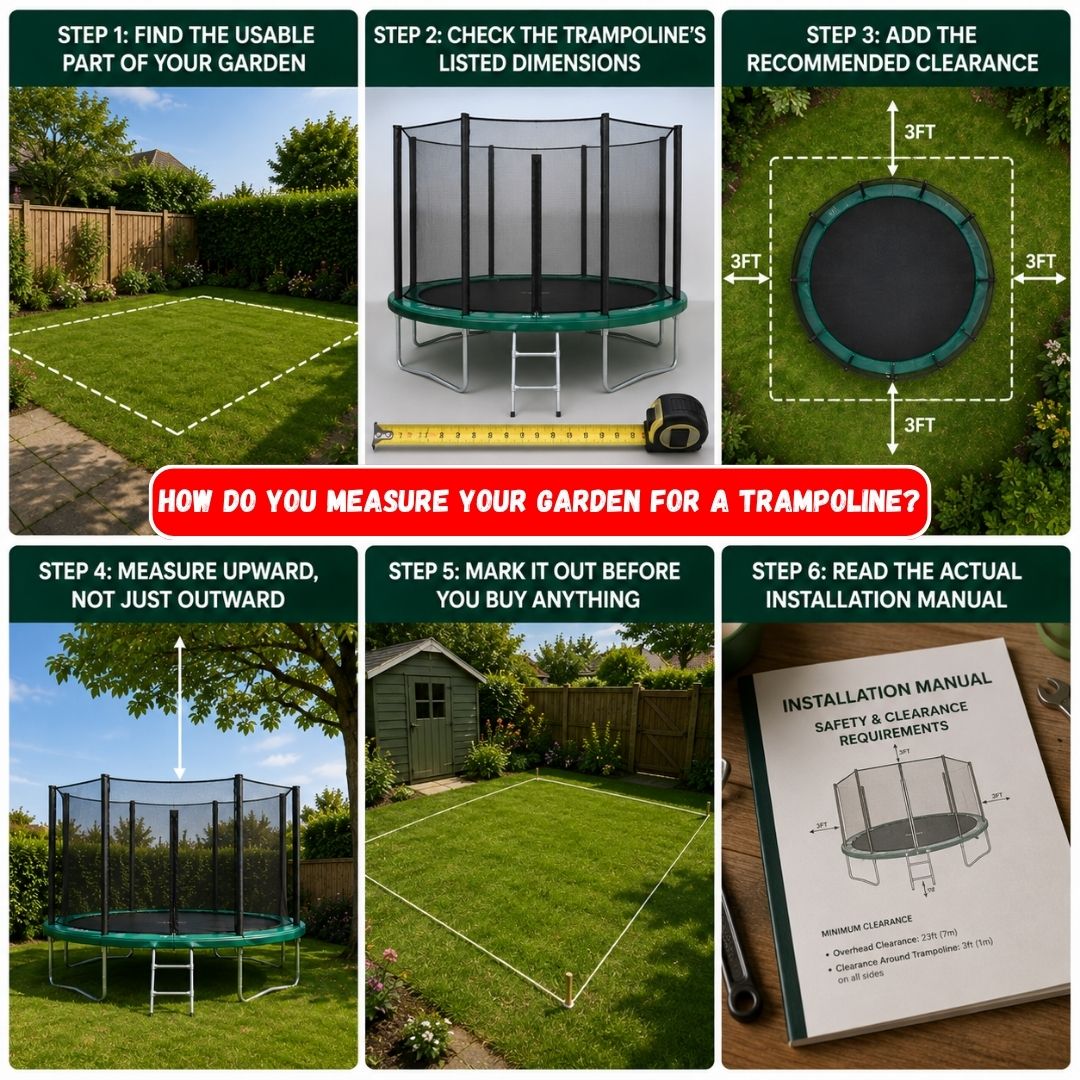
This part doesn’t need any special tools, just a tape measure, a bit of string, and ten minutes outside will do it.
Step 1: Find the Usable Part of Your Garden
Don’t measure the whole plot. Most gardens have a section that’s flat, unshaded, and free of features like flower beds or a patio. That’s the space you’re actually working with.
Step 2: Check the Trampoline’s Listed Dimensions
Look up the width, length, or diameter from the manufacturer’s spec sheet. Remember: this is the mat size, not the space required.
Step 3: Add the Recommended Clearance
Add the clearance figure to every side of the trampoline, not just one. A 10ft trampoline with 3ft of clearance on each side needs roughly 16ft of total width: the trampoline plus 3ft on either side.
Step 4: Measure Upward, Not Just Outward
Stand where the trampoline will go and look for anything overhead: tree canopies, roof edges, or cabling. If there’s any doubt, choose a different spot.
Step 5: Mark It Out Before You Buy Anything
Use string, a garden hose, or even a few canes to mark the full footprint on the ground. Walk around the edge of it. Does it still leave room to get past comfortably? Does it block the shed door or a side gate? You’ll spot problems now that are much harder to fix once a trampoline is assembled.
Step 6: Read the Actual Installation Manual
Clearance requirements aren’t identical across brands. A trampoline with a deeper spring bed or a different enclosure design may call for more room than a similarly sized model from another manufacturer.
What Size Trampoline Can Fit in Your Garden?
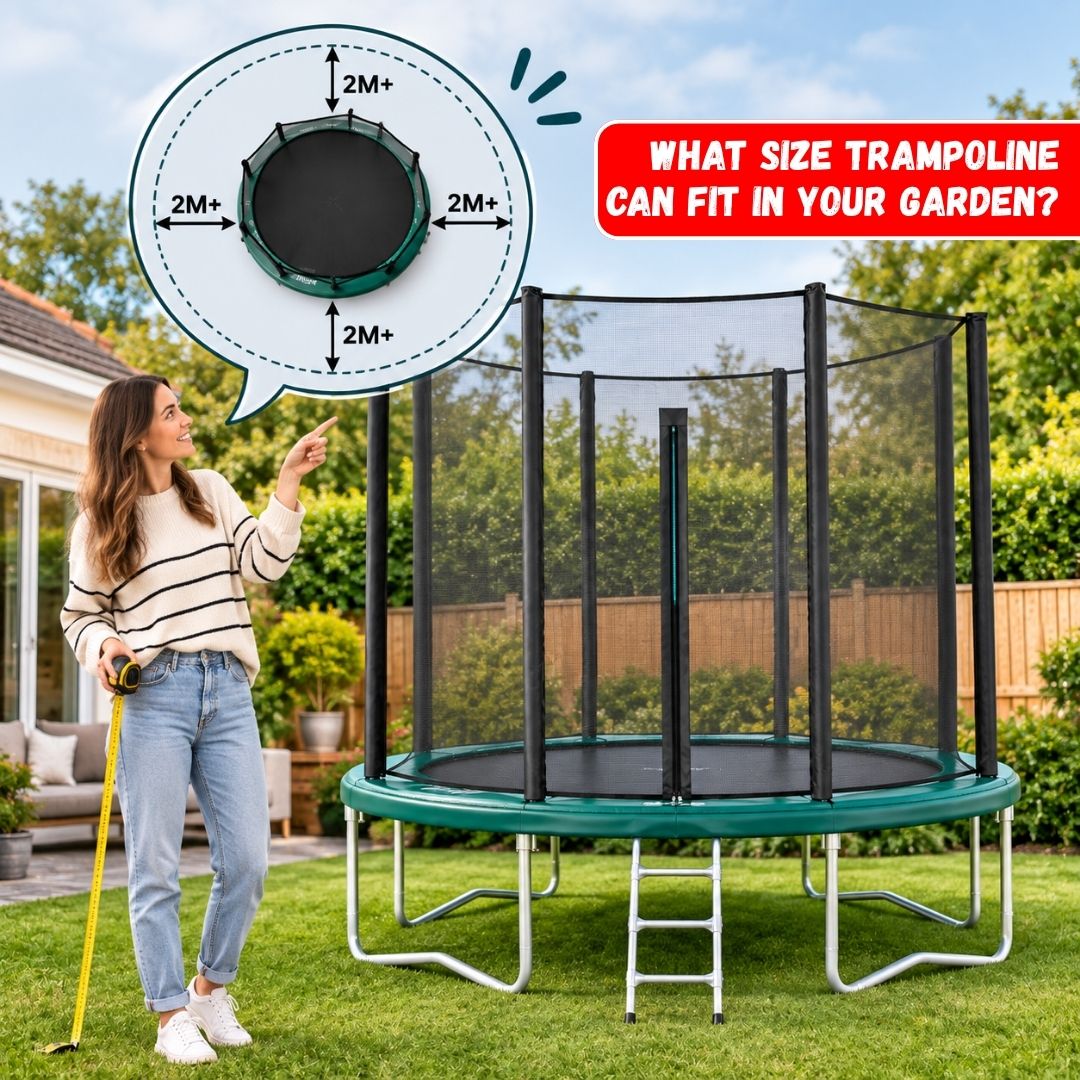
This is where garden shape and trampoline size need to be considered together, rather than trampoline size in isolation.
Space You Need for a 6ft Trampoline
Compact models like this suit smaller gardens or younger children who don’t need a large bounce area. Even so, the same clearance principle applies. Check the manufacturer’s figure and add it to the 6ft footprint rather than assuming a tiny garden automatically has room.
Space You Need for an 8ft Trampoline
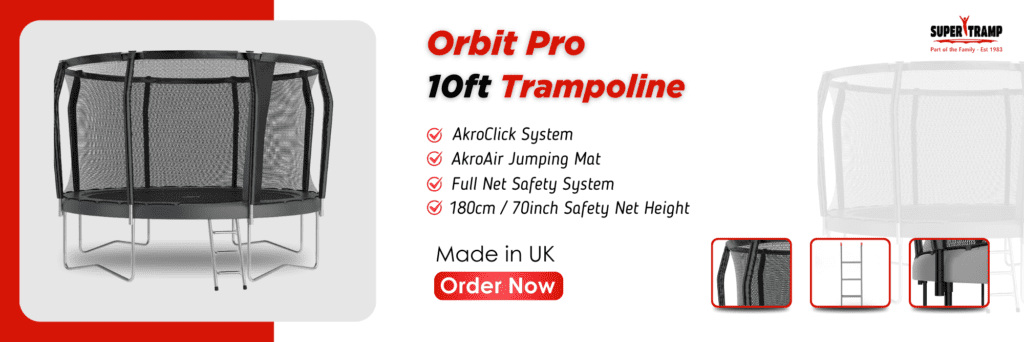
An 8ft trampoline, like the Orbit 11x8ft rectangular trampoline is a popular choice for compact gardens and younger users. With typical clearance added, you’re often looking at somewhere in the region of 13–14ft of total garden width, though this varies by brand.
Space You Need for a 10ft Trampoline
A 10ft trampoline is one of the most searched sizes, and for good reason, it suits a wide range of garden sizes. Using the earlier example, 10ft plus 3ft clearance on either side comes to roughly 16ft. It’s a useful benchmark, but don’t treat it as a guideline; always check your specific model.
Round vs Rectangular Trampolines: Which Needs More Space?
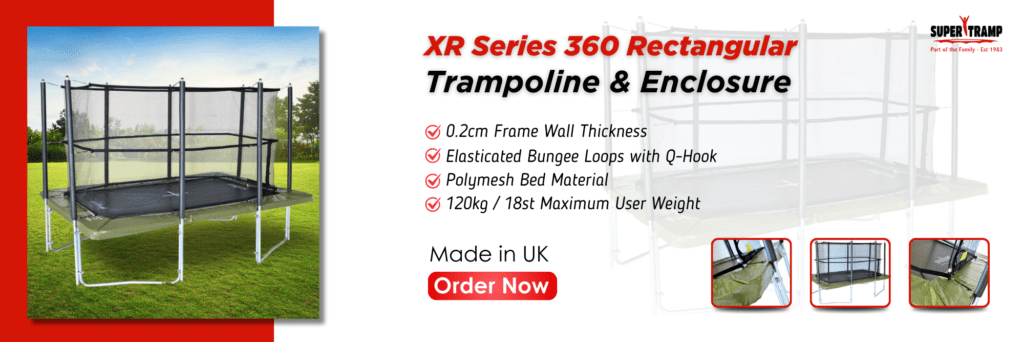
Round trampolines are the most common choice for family gardens and tend to work well in square or roughly circular spaces. Rectangular or square models can be a better fit for long, narrow gardens, since you can align the longer edge with the length of the plot.
Neither shape is automatically better. What matters is how well the shape matches your garden’s actual dimensions, not just the total square footage available. A rectangular trampoline squeezed diagonally across a garden rarely works, measure the straight lines you’ve genuinely got to play with.
Trampoline Placement: In-ground vs Above-ground
An above-ground trampoline needs open, flat space with several metres of clearance on every side, away from fences, trees, and washing lines. It sits on your lawn or patio, so you’ll want soft ground underneath, like grass, rather than concrete, in case of falls.
An in-ground trampoline is set into a dug-out pit, so the jumping surface sits level with the garden. This changes where it can go: you’ll need access for digging equipment, good drainage away from the pit (to stop it flooding), and enough surrounding lawn to fit safely. It also works better near patios or seating areas, since there’s no tall frame blocking the view.
Where is the Safest Place to Put an Outdoor Trampoline?
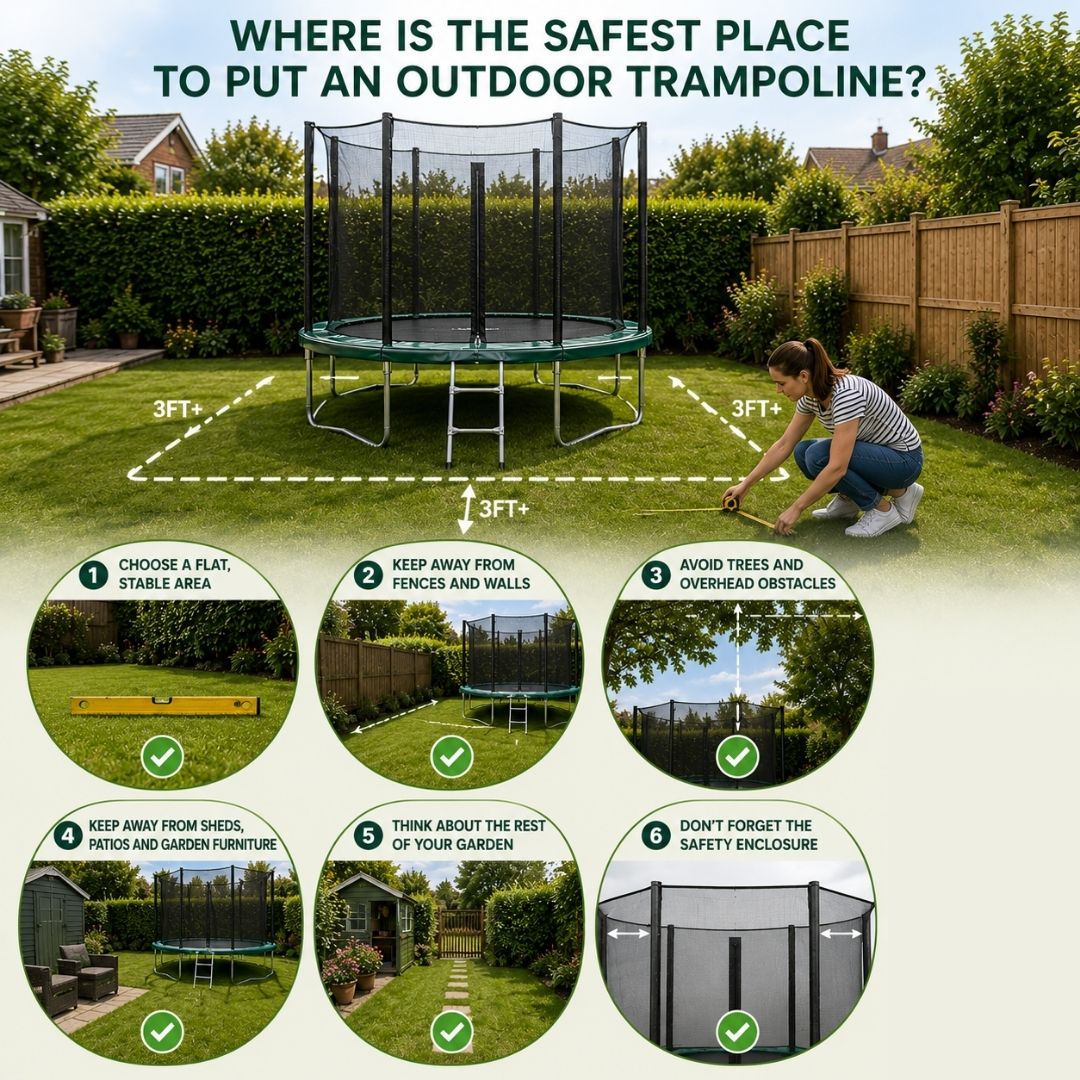
You’ll need the trampoline’s size plus a safety clearance around it. Aim for at least 3 feet of space on every side and more if you have a net or enclosure. Choose a flat, level spot away from trees, walls, and hard surfaces like concrete or fences to reduce injury risk.
Choose a Flat, Stable Area
Uneven ground can make trampolines sit unevenly, which affects both bounce and frame pads‘ stability. A-level base isn’t a nice-to-have. It’s fundamental to safe use.
Keep Away From Fences and Walls
Positioning a trampoline directly against a boundary removes your clearance zone entirely. Leave the full recommended gap, even if that means the trampoline sits more centrally in the garden than you’d first imagined.
Avoid Trees and Overhead Obstacles
Low branches are an obvious hazard, but also think ahead: a tree that clears the area comfortably now might not in five years’ time.
Keep Away From Sheds, Patios and Garden Furniture
Hard surfaces nearby turn a minor fall into a much more serious one. Patios, decking edges and furniture with sharp corners should sit well outside the clearance zone.
Think About the Rest of Your Garden
Children need room to get on and off safely, not just room to bounce. Avoid placing the trampoline somewhere it blocks a side gate, a shed door, or your main route through the garden. If you’re planning any landscaping down the line, factor that in now rather than moving a trampoline later.
Don’t Forget the Safety Enclosure
The netting and support trampoline poles add extra width beyond the mat itself. When you’re calculating total space, measure the complete assembled unit enclosure, not just the bouncing surface.
Once you have chosen the right location, the right add-ons can make everyday use safer and more comfortable. Our guide to essential accessories explains how features such as safety nets, frame pads, anchor kits and weather covers can protect both jumpers and the trampoline itself.
Things to Remember
- Measure the usable part of your garden, not the whole plot.
- The trampoline’s advertised size is the mat size, not the total space required.
- Add the manufacturer’s recommended clearance to every side.
- Keep fences, walls, trees, sheds, and furniture out of the clearance zone.
- Check overhead space for branches, cables, and roof lines.
- Match the trampoline’s shape to your garden’s actual layout.
- Always check the specific installation instructions for your model.
- If space is tight, choose the trampoline size after measuring, not before.
- Include the safety net and poles in your measurements, not just the mat.
- Never trade safety clearance for a bigger trampoline.
Conclusion
Buying a trampoline isn’t really about finding one that physically fits in the garden. It’s about making sure there’s enough room for the trampoline itself, a proper clearance zone around it, and clear space above it too. Skip that step, and you’re left working around obstacles you should have measured for in the first place.
Before you buy, grab a tape measure and mark out the full footprint of the trampoline plus its required clearance. If everything fits comfortably, with room left to walk around and get on and off safely, you’re in good shape for a safer garden-bouncing space.
Once you know the size that works for your garden, explore the range of Supertramp trampolines to find an option that suits your available space, your family and the way you plan to use it. Check the product dimensions and safety guidance for your chosen model, then order with confidence knowing you have planned for a safer, more enjoyable setup.